Fragrance is woven into so many of our everyday rituals.
It is in the shampoo we use in the shower, the hand wash beside the sink, the laundry detergent that makes our clothes smell familiar, the perfume we apply before leaving the house and the candle we light at the end of the day.
Scent can be comforting, nostalgic and deeply personal. It can change the atmosphere of a room, evoke a memory or help us feel more like ourselves.
But because fragranced products are chosen individually, it is easy to overlook how many of them we use across a single day.
A cleanser may contain parfum. So might a moisturiser, shampoo, deodorant, body lotion, hand cream, fabric conditioner, room spray and household cleaner.
Used together, these products contribute to the chemical and sensory environment we move through every day.
For me, that makes synthetic fragrance worth looking at more closely.
What do “fragrance” and “parfum” mean?
On an ingredients list, the words fragrance and parfum usually refer to a scent mixture rather than one individual ingredient.
A fragrance formula may be made up of numerous aromatic substances, and those individual components are not always named separately on the product label.
This can make it difficult for the person using the product to understand exactly what the fragrance contains.
My concern is not limited to an immediate reaction such as a headache, nausea, skin irritation or sensory overwhelm.
Some substances used within fragrance formulations have also raised concerns around endocrine activity. Endocrine disrupting substances may interfere with the body’s hormonal signalling, and their effects are not necessarily something we immediately see or feel after using a product.
That is why I believe the conversation around fragrance applies to more than those who identify as sensitive.
Why repeated exposure matters
One fragranced product may feel insignificant.
But synthetic fragrance rarely appears in just one part of a routine.
It can be found in:
- skincare
- haircare
- deodorant
- perfume and aftershave
- body lotion
- hand wash
- laundry detergent
- fabric conditioner
- candles
- room sprays
- household cleaning products
This repeated exposure is what I think of as an invisible load.
It is not necessarily one dramatic event. It is the accumulation of small, repeated exposures through the products we use on our skin, inhale in our homes and carry with us on our clothes.
For me, synthetic fragrance and parfum are not ingredients I believe belong in products we repeatedly use on our skin, in our homes or around our bodies.
I do not believe they are necessary for a product to feel luxurious, effective or enjoyable.
This does not mean changing everything overnight
My approach is not about fear or trying to create a perfectly controlled life.
It is about knowledge, context and making sensible changes where the benefit is clear.
Most of us have built our routines gradually. It is unrealistic, expensive and overwhelming to replace every product at once.
A more sustainable approach is to choose one category at a time.
You might begin with:
- laundry detergent
- fabric conditioner
- hand wash
- candles
- body lotion
- household sprays
Look for the words parfum, fragrance, perfume or aroma on the label.
Then choose one product to use up and replace with an unscented or naturally aromatic alternative when it is finished.
One thoughtful change at a time can significantly alter the overall fragrance profile of your home without making the process feel restrictive.
The Kyūshi approach to fragrance
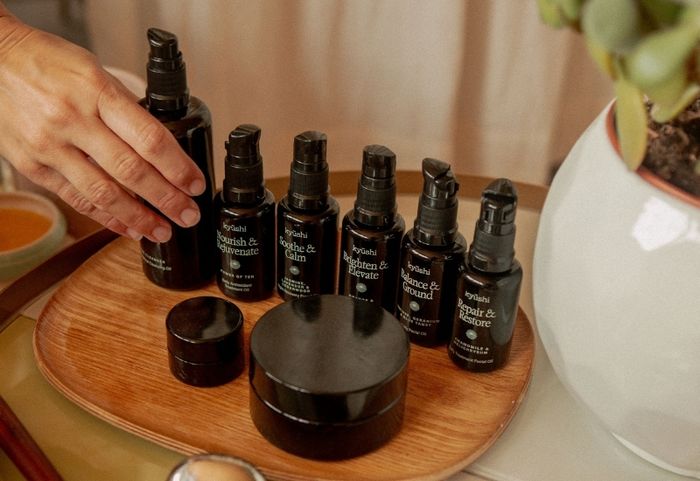
At Kyūshi, we do not add synthetic fragrance or parfum to our skincare.
Our aromatic formulas are essential-oil based, with each oil chosen for its functional role within the formulation rather than simply to make the product smell appealing.
For those who prefer to avoid scent altogether, or whose skin does not tolerate essential oils, Cleanse & Protect and Nourish & Rejuvenate are both essential-oil free.
This allows the routine to be adapted to the individual, because sensitivity is not one-size-fits-all.
Some people are comfortable with carefully selected essential oils, while others find that even naturally aromatic ingredients are too much for their skin or senses.
The important thing is not to force the skin to tolerate a product because it is described as natural. It is to choose the formulation that feels most supportive and appropriate for you.
The scent of our essential-oil-based products comes from the ingredients themselves.
For me, that distinction is important.
A product does not need added synthetic perfume to feel beautiful to use. Its texture, ritual, botanical ingredients and the way it supports the skin can provide that experience.
As a formulator, I want every ingredient to have a reason to be there.
Look beyond the bathroom cabinet
Fragrance exposure is not limited to skincare.
The products used to clean our clothes, scent our rooms and wash our homes can become part of our daily environment without us giving them much thought.
This is why I encourage people to look at the routine as a whole.
Ask:
Where does synthetic fragrance appear most often in my day?
Is this exposure necessary?
Could an unscented or naturally aromatic alternative serve me just as well?
Which product would be easiest to replace first?
This is not about becoming frightened of your home or everything inside it.
It is about becoming more aware of what surrounds you and making choices that feel informed, practical and supportive.
A wider view of wellness
The same principle sits at the heart of my one-to-one wellness consultations.
We look beyond a single product or symptom and consider the wider environment the body is responding to.
That may include:
- skincare and personal-care products
- fragrance and household products
- food and hydration
- sleep and daily rhythm
- the home, workplace and car
- nervous-system support
- practical ways to support hormonal balance
I do not work from fear.
I work from knowledge and risk versus reward.
We look at what is already supporting you, where an exposure may be unnecessary and which changes are most likely to make a meaningful difference.
Sometimes the most supportive change is not dramatic.
It is simply replacing one everyday product with something more considered, then allowing that choice to become part of your routine.
Explore one-to-one wellness consultations.