There has never been more choice in skincare.
Every week seems to bring another ingredient to know about, another serum to layer in, another reason to wonder whether the routine you already have is somehow incomplete.
I understand the appeal. I have spent years working with skin, formulating skincare and testing products, and I still find new ingredients interesting.
But interest and necessity are not the same thing.
Some of the healthiest skin I see is not supported by the longest routine. It is supported by a routine that is understood, appropriate and used consistently.
And sometimes, when the skin becomes confused, reactive or difficult to read, the most useful thing we can do is simplify.
When skincare becomes too much
Skincare is often sold to us one ingredient at a time.
Vitamin C for brightness.
Retinoids for lines.
Acids for texture.
Peptides for firmness.
Niacinamide for pores.
Each may have a place. But the skin never experiences them as isolated marketing claims. It experiences the complete formula, and then everything else we layer alongside it.
The more products we introduce, the more variables we create.
That does not automatically make a routine harmful, but it can make it much harder to understand what is actually helping.
If your skin suddenly begins to sting, feels tight despite looking shiny, becomes increasingly reactive, or seems calmer on the days you do very little, it may be worth looking at the routine before buying something new.
A good ingredient is not the same as a good product
This is something I come back to again and again as a formulator.
A product cannot be judged by one ingredient alone.
The concentration matters. The ingredients surrounding it matter. The texture, delivery system and overall formulation matter. Most importantly, the skin it is being applied to matters.
A fashionable ingredient in the wrong formula may not suit you at all.
A beautifully balanced formula made from less fashionable ingredients may be exactly what your skin needs.
This is why I would always rather someone choose a product for the way it has been formulated and the purpose it serves than because one ingredient on the front of the bottle happens to be trending.
Start with the job the product needs to do
When I look at a skincare routine, I tend to think about function before product category.
Does the skin need to be cleansed more gently?
Does it need support because the barrier feels compromised?
Does it need more comfort?
Is there actually a problem to solve, or have we simply been persuaded that there should be one?
For most people, a good routine can begin with three very simple questions:
How am I cleansing?
What does my skin need after cleansing?
Does it need an additional layer of moisture or protection?
That is essentially how the Kyūshi routine was created.
Cleanse without taking too much away
Cleansing should remove what needs to be removed without leaving the skin feeling stripped.
That sounds obvious, but the sensation of extremely clean, squeaky skin has been marketed as desirable for a very long time.
The skin barrier relies on lipids and other components that we do not want to continually remove and replace.
Cleanse & Protect was created with that in mind: to cleanse effectively while respecting the skin that is left behind.
The aim is not to make the skin feel dramatically different after cleansing.
It is to leave it feeling comfortable enough that you almost forget you have done it.
Choose the treatment step your skin actually needs
This is where I think skincare can become unnecessarily complicated.
We often layer several serums because each promises a different benefit.
Instead, I prefer one considered treatment step chosen around the skin in front of me.
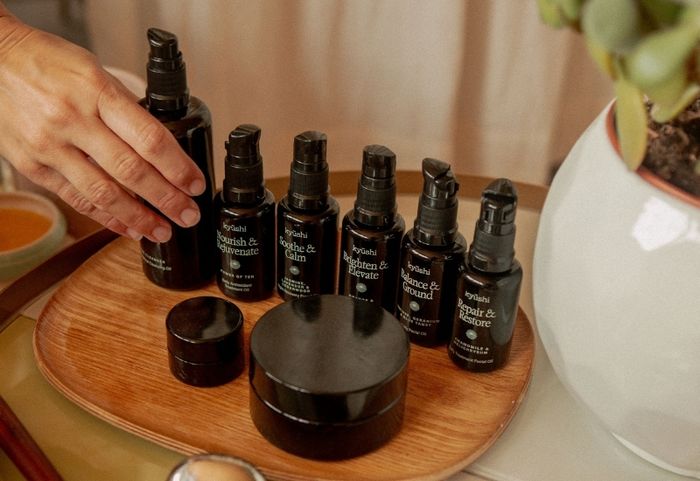
For Kyūshi, that is usually one of the facial oils.
Each formula has been created as a complete blend rather than around one hero ingredient. The botanical oils and supporting ingredients are selected to work together, with different formulations available depending on what the skin needs.
The aim is not to collect them all (but be my guest if you want to)
It is to find the one that suits your skin in its current season.
Add more only when it adds something
There are times when the skin needs an additional layer of moisture and comfort.
Weather changes. Heating goes on. We travel. Hormones shift. The skin can simply feel different from one month to the next.
That is when Moisturise & Revive may become part of the routine.
But I do not believe every person needs every product every day simply because it exists.
A routine should be able to change with the skin.
That flexibility is very different from constantly changing the routine.
Consistency is less exciting than novelty, and often more useful
One of the hardest things about skincare is giving it time.
We are surrounded by before and after images, instant transformations and products designed to create a very noticeable first impression.
Healthy skin is usually less dramatic.
It is built through the small things we repeat.
Cleansing without over-cleansing.
Using a formulation that suits the skin.
Supporting the barrier.
Protecting the skin from excessive sun exposure.
Eating, sleeping and living in ways that support the wider body.
And then doing those things often enough that the skin has some consistency to work with.
Simplicity becomes particularly valuable when life is not simple
This is something I am reminded of whenever I travel.
For years, much of my work meant living out of a suitcase: film sets, hotels, flights and constantly changing environments.
You quickly discover which products you genuinely rely on when you have to carry everything with you.
A routine that only works when you have twelve bottles lined up neatly in your bathroom is not necessarily a routine that fits easily into life.
There is a freedom in knowing that you have a few products you understand and trust, whether you are at home, in a hotel or getting ready for an early call time somewhere unfamiliar.
That is still how I like skincare to feel.
Simple enough to live with.
Considered enough to support the skin well.
Less does not mean doing nothing
Simplifying skincare is sometimes misunderstood as being anti-treatment, anti-actives or anti-results.
It is none of those things.
There are times when a targeted ingredient, treatment or professional intervention is entirely appropriate.
The point is that it should have a reason to be there.
I am interested in doing what is useful, rather than doing something simply because we can.
That may mean adding a treatment.
It may mean changing a product.
And sometimes, it may mean leaving the skin alone for a while.
Before you buy another serum
The next time something catches your attention, pause before adding it to your routine.
Ask yourself:
What am I hoping this will change?
Is that something my skin is actually asking for?
Do I already own a product doing the same job?
Have I given my current routine enough time?
Am I interested in the formulation, or simply the ingredient being advertised?
There is nothing wrong with enjoying skincare or being curious about something new.
But a product should earn its place.
Healthy skin does not require constant intervention.
It requires us to pay attention, understand what it is telling us and support it well enough that it can continue doing what skin is designed to do.
Sometimes that means adding something.
And sometimes the most useful thing you can add to your routine is simply a little more consistency.